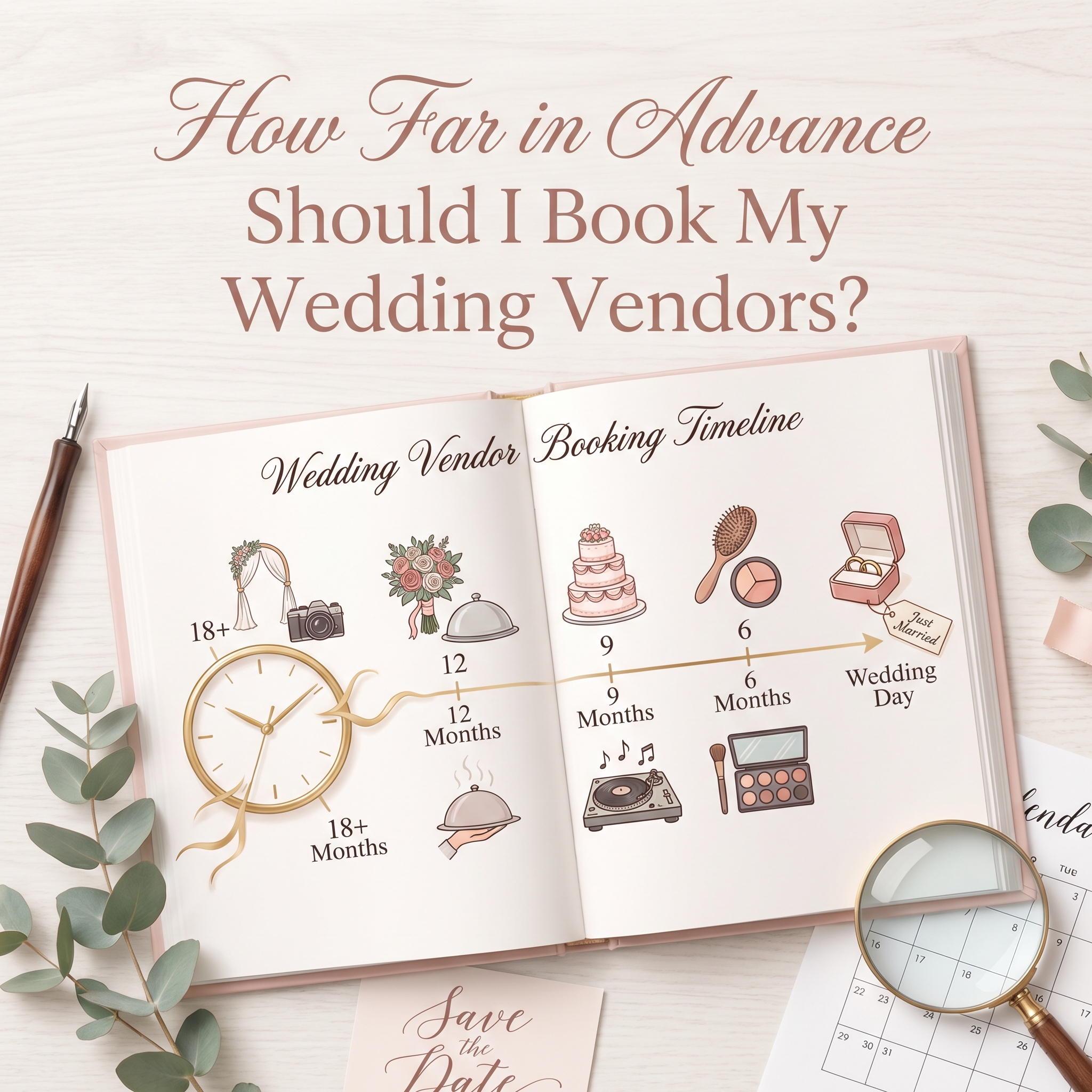
How Far in Advance Should I Book My Wedding Vendors?
Filed in Featured, Wedding Tips / April 15, 2026 /




One of the first questions couples ask after getting engaged is some version of: “Okay, so when do we actually need to start booking people?” And the honest answer is: sooner than you think, and it depends on which vendor you’re talking about.
Some wedding vendors book up twelve to eighteen months out. Others can be confirmed in a matter of weeks. Booking in the wrong order — or waiting too long on the wrong vendor — is one of the most common and most avoidable sources of stress in wedding planning.
This guide breaks it down by vendor category, explains why the timelines are what they are, and gives you a clear picture of what to prioritize the moment you have a date.
The Rule That Applies to Everything
Before the specifics: the vendors most couples regret not booking sooner are always the ones where availability is genuinely limited. A venue can only host one wedding per day. Your photographer can only shoot one wedding per Saturday. Your DJ can only be in one place at a time.
Unlike most purchases, booking a wedding vendor is not just about whether they’re available right now — it’s about whether they’ll be available on a specific Saturday in the future. And on popular wedding dates (spring Saturdays, fall weekends, holiday-adjacent Fridays), that scarcity gets real fast.
The general principle: book the vendors that can only be in one place at once as early as possible. Book the vendors with more flexibility later.
Venue — 12 to 18 Months Out
Your venue is the first thing you book. Full stop. Everything else — the date, the guest count, the ceremony and reception structure — flows from the venue. You cannot meaningfully book any other vendor until you know where and when your wedding is happening.
Popular venues in any market fill their prime Saturday dates 12 to 18 months in advance, sometimes more. If you have a specific venue on your list and a specific season in mind, assume that the overlap between “the date I want” and “the venue being available” is narrow. Move on this one first.
Once you have a venue and a date confirmed, everything else can start falling into place.
What to do immediately: Tour your top two or three venues, request pricing and availability for your target dates, and once you’ve found the right fit, sign and deposit as fast as you can. Venues will not hold a date without a deposit — and in most markets, someone else is one phone call behind you.
Wedding Photographer — 10 to 14 Months Out
Your photographer is the second thing you book, and it’s not close.
Here’s why this matters more than couples expect: the best photographers in any market — the ones whose portfolios make you say “I want that” — are working with a hard limit. They take one wedding per day. On the most sought-after dates (May through October Saturdays in particular), the photographers couples want most can be fully booked 12 to 14 months ahead.
This isn’t scarcity marketing. It’s math. A photographer doing 30 weddings a year has 30 Saturdays available. If half of those couples book 12 months out, the back half of the calendar fills fast.
At Promani Weddings, our most popular dates regularly book out well over a year in advance. Couples who reach out six months before their date and ask about a peak Saturday are often disappointed. We genuinely wish we could help them — and we can’t.
What to do: Start researching photographers while you’re still finalizing the venue. If you find a portfolio you love, reach out before the date is locked if possible — photographers will often tell you whether they have availability in a general window and can hold a tentative date while you confirm your venue.
Videographer — 10 to 14 Months Out
The booking timeline for videographers mirrors photographers almost exactly, and for the same reason: one videographer, one wedding per day. If you’re booking photo and video separately, treat them with equal urgency.
If you’re booking them as a package through the same company — which we’d recommend for the coordination benefits we’ve talked about elsewhere — this timeline applies to the whole package. One booking covers both.
One thing couples sometimes get wrong: assuming they can add video later after booking a photographer. In many cases, the videographer they want is already booked for that date by the time they circle back. Make the photo and video decision together, early.
Wedding DJ — 9 to 12 Months Out
DJ availability varies more by market than photography does, but the same fundamental scarcity applies: one DJ, one wedding per Saturday. In larger markets and during peak season, the DJs couples want — with real wedding experience, good reviews, and professional equipment — book out 9 to 12 months in advance.
Budget DJs and newer DJs may have more availability closer in, but that’s often for reasons worth understanding before you book someone late.
What to do: Once your venue and date are confirmed and you’ve secured photo and video, make the DJ your next call. It’s the last of the “one per Saturday” vendors that deserves high-urgency booking.
Wedding Planner or Day-of Coordinator — 10 to 12 Months Out
If you’re hiring a full-service wedding planner, they need to be involved from the start — so book them as early as your venue, ideally before or alongside it. Their whole job is to help you navigate the rest of the planning process, and that job starts well before the wedding day.
If you’re hiring a day-of coordinator (someone who manages logistics on the actual day without being involved in planning), the urgency is slightly lower — but good coordinators still book 10 to 12 months out in peak season. Don’t treat this as a last-minute add-on.
Caterer — 9 to 12 Months Out
Catering timelines depend heavily on whether your venue has an in-house caterer or requires you to bring one in. If your venue has a preferred or exclusive caterer, that’s one decision made for you the moment you sign the venue contract.
If you’re sourcing a caterer independently, treat the booking window similarly to a DJ — 9 to 12 months out for popular caterers during peak season. The best catering companies fill their calendars quickly, and food is too important a part of the guest experience to leave to whoever is still available three months before your wedding.
Florist — 8 to 10 Months Out
Florists are a little more flexible than photographers or DJs because a single florist can handle multiple weddings on the same weekend with good planning — but the best florists in any market still fill their calendars 8 to 10 months out, especially for large or complex arrangements.
If you have a very specific floral vision — certain flowers, a particular aesthetic, a designer whose portfolio you love — book earlier rather than later. If your vision is more flexible, you have a bit more breathing room.
What to do: Have a sense of your general aesthetic before you meet with florists, and be ready to provide your color palette, venue details, and approximate guest count. Florists use all of that to assess scope and availability.
Hair and Makeup — 6 to 9 Months Out
Popular bridal hair and makeup artists fill their best dates 6 to 9 months out. If you have a specific artist whose work you love from Instagram or from a friend’s wedding, reach out earlier. If you’re more flexible, you have a bit more time — but don’t wait until three months out and expect your top choice to be available on a peak Saturday.
One thing to consider that couples often overlook: your hair and makeup artist needs to understand the full scope of the getting-ready morning — how many people are in the bridal party, whether any bridesmaids are also getting their hair and makeup done, and roughly when the morning needs to wrap up. That affects how many stylists they bring and how they schedule the morning. Give them that information when you first reach out.
Officiant — 6 to 9 Months Out
If you’re using a venue-provided officiant or a religious officiant through your church or place of worship, the timeline is determined by their calendar — ask as soon as your date is set.
If you’re hiring an independent officiant, 6 to 9 months out is a safe window for most markets. In smaller or rural areas, popular officiants may book faster than that, especially if they do a limited number of weddings per year.
If a close friend or family member is getting ordained to marry you — a growing and genuinely lovely option — the “booking” timeline is a conversation rather than a contract, but have that conversation early so they can prepare and understand what’s expected of them.
Rehearsal Dinner Venue — 4 to 6 Months Out
Private dining rooms and event spaces for rehearsal dinners are a lower-urgency booking than your wedding vendors, but popular restaurants with private rooms in wedding-heavy markets still fill their weekend calendars. Four to six months out is the right target, especially if you have a specific restaurant in mind.
Transportation — 4 to 6 Months Out
Whether you’re arranging a shuttle for guests, a getaway car for the couple, or both, 4 to 6 months is typically enough lead time. Limos, vintage cars, and shuttle services do book out during peak season, so don’t treat this as a week-before errand — but it’s one of the more forgiving bookings on the list.
The Wedding Cake or Desserts — 4 to 6 Months Out
Bakers and cake designers who are known for their work book 4 to 6 months in advance for wedding season. Schedule a tasting and consultation early enough to allow for design discussions, trial batches if applicable, and delivery logistics.
Stationery — 4 to 6 Months Out
Invitations need to go out 6 to 8 weeks before the wedding, and custom stationery takes time to design, proof, print, and address. Start the stationery process 4 to 6 months before the wedding to give yourself a comfortable window for all of that.
The Summary: A Booking Timeline
Here’s the full order of priority, from most to least urgent:
Book immediately after getting engaged:
- Venue (this unlocks your date and determines everything else)
Book within 1–2 months of securing your venue:
- Wedding photographer
- Wedding videographer (or photo + video package together)
- Wedding planner (if using a full-service planner)
Book 9–12 months before the wedding:
- Wedding DJ
- Caterer (if not provided by venue)
- Wedding coordinator (day-of)
Book 6–9 months before the wedding:
- Florist
- Hair and makeup artists
- Officiant
Book 4–6 months before the wedding:
- Rehearsal dinner venue
- Transportation
- Wedding cake / desserts
- Stationery
What Happens If You’re Planning a Short Engagement?
Short engagements — six months or less — are more common than people think, and they’re completely doable. The approach is just different: you move faster, you’re more flexible, and you accept that some of your first-choice vendors may not be available.
The priorities don’t change. Venue first, then photo and video, then DJ. You compress the timeline, but the order stays the same. The vendors most likely to still have availability last-minute are the ones with more flexible schedules — officiants, transportation, bakers. The ones most likely to be unavailable are the high-demand photographers and DJs who book year-round.
If your date is flexible — if you’re open to a Friday or Sunday, or a winter wedding rather than a fall one — your odds improve significantly. The most popular vendors often have weekday or off-peak availability well into the future, and a Friday night wedding can be just as beautiful as a Saturday one at a fraction of the competition.
A Note on Booking Through Promani
At Promani Weddings, we offer photography, videography, DJ services, and content creation as a coordinated package — which means booking one company covers the vendors that are most time-sensitive and most dependent on each other. Our coverage dates for peak season fill up quickly, and we’d love the chance to be part of your day.
If you’ve just gotten engaged and are starting to figure out your timeline, a quick call with our team is a great place to start. We can tell you exactly what’s available for your date and help you think through the rest of the planning calendar.
We work with couples across Utah, Colorado, Tennessee, Michigan, Virginia, Washington, Oregon, Illinois, Indiana, North Carolina, Massachusetts, and Idaho — and every market has its own booking rhythms. We’re happy to give you a realistic picture of what to expect wherever your wedding is.
Final Thought
The couples who end up with their ideal vendor team almost always have one thing in common: they started early. Not because they were obsessive planners, but because they understood that availability is a real thing, and that the vendors they wanted most were the ones everyone else wanted too.
Book the irreplaceable vendors first. Give yourself options on the flexible ones. And enjoy the engagement — the planning is part of the adventure.
Promani Weddings offers wedding photography, videography, DJ services, and content creation across Utah, Colorado, Tennessee, Michigan, Virginia, Washington, Oregon, Illinois, Indiana, North Carolina, Massachusetts, and Idaho. View our packages or reach out to start planning your day.


Free
Inspiration
recently on the journal
Previous Post:


